
Growing up in a Butcher’s Shop
Henry’s future wife Katharina was a butcher’s daughter. She grew up in the 1940s in a house-cum-butcher’s shop in Köniz, a village near Bern in Switzerland.
The Butcher’s Shop
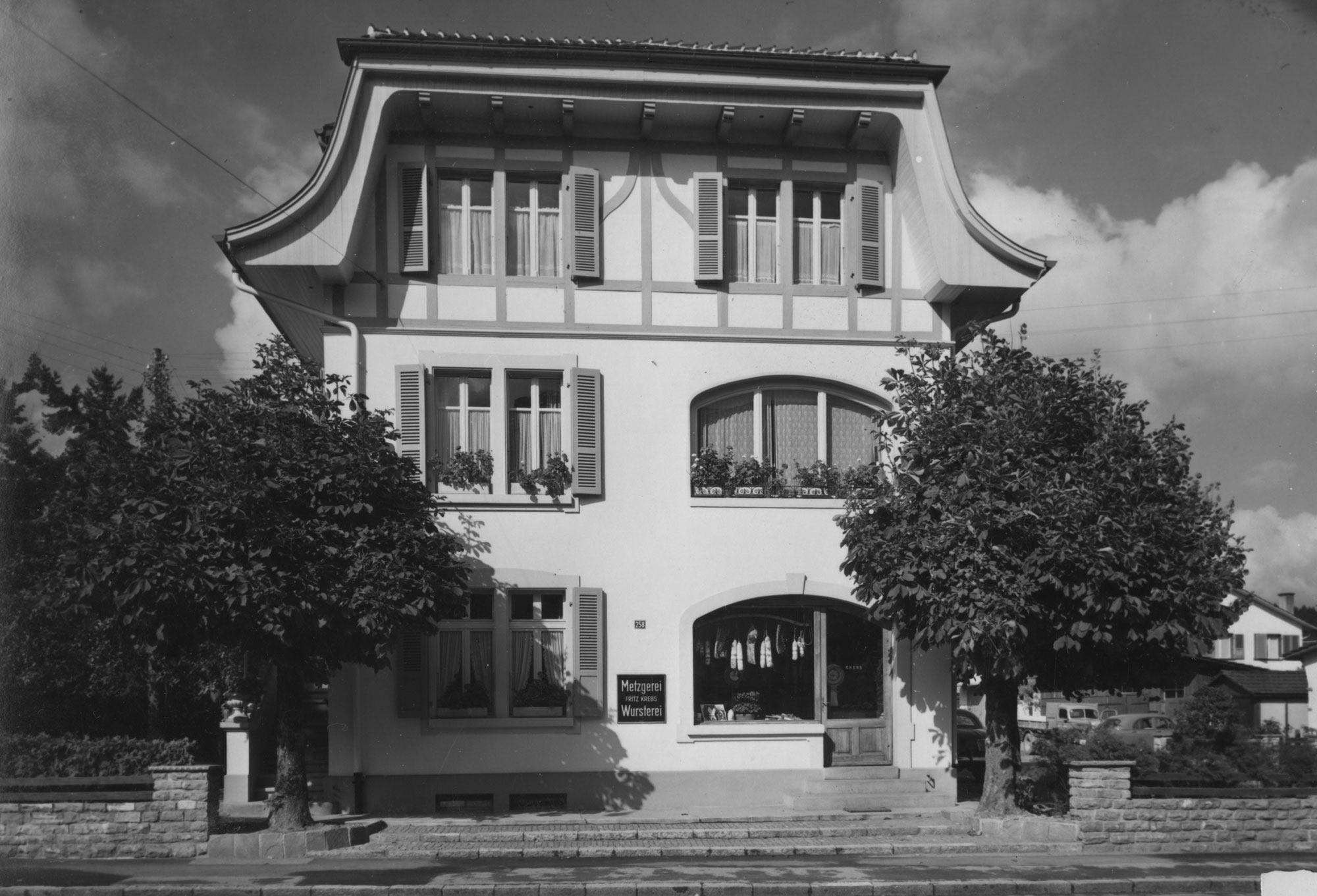
The front of the house that Katharina grew up in. The door at the bottom right was the entrance to her father Fritz Krebs’s butcher’s shop, and next to it was the shop window – you can see salami and other meat products hanging in it. Behind the shop was a work room for preparing meat. The other windows on the ground and first floors belonged to rooms that the family lived in. The room under the eaves on the left was where Katharina’s paternal grandmother – the owner of the dog Erlo – lived. An employee lived in the room under the eaves on the right. In the basement of the house were various cool and freezer rooms.
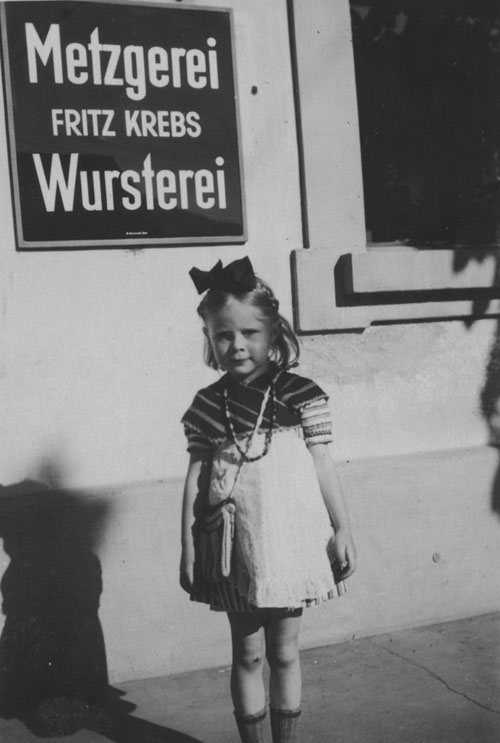
Katharina in front of her father’s butcher’s shop in 1945.
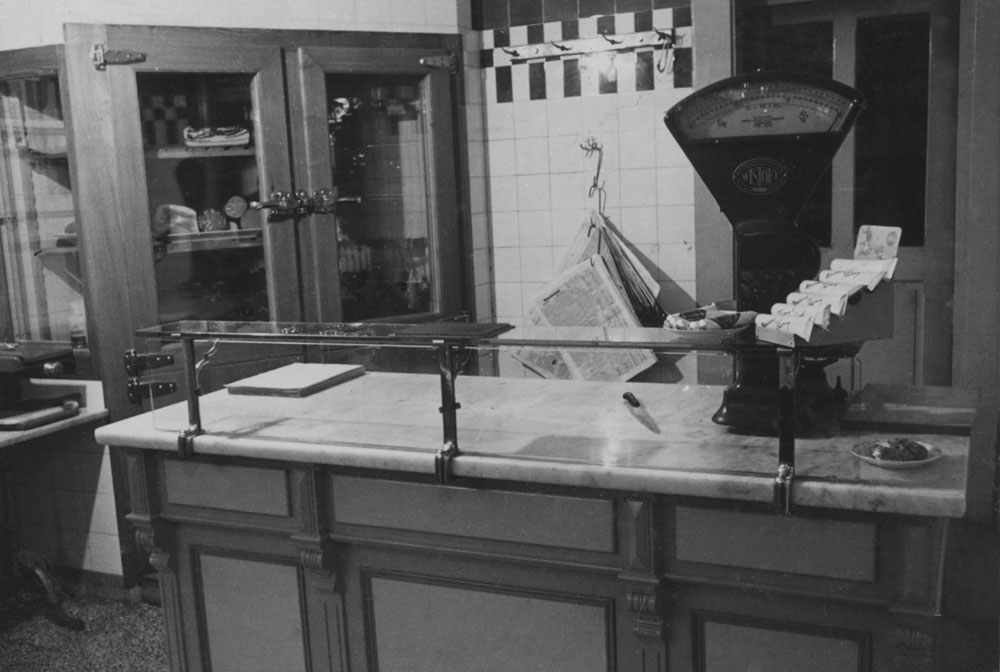
Inside the butcher’s shop. The cabinet on the left is a fridge containing meat products, Sauerkraut and other cool goods. The marble counter would have had meat displayed on it during the day. Behind on a hook are newspapers that were used to wrap up the meat for customers.
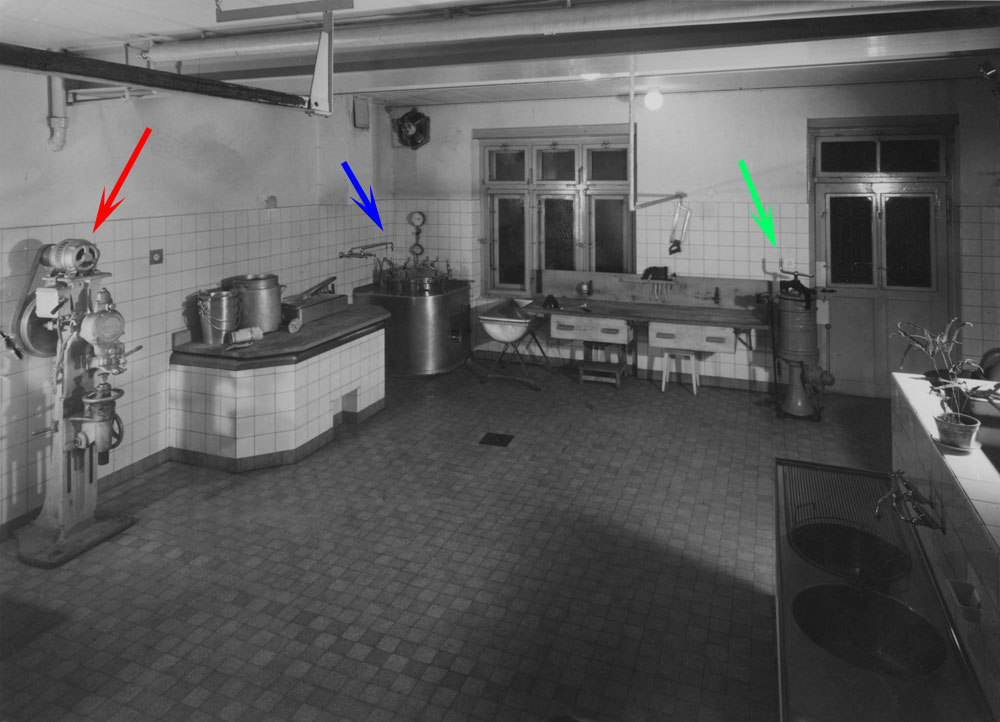
The work room.
In the photograph above, the machine arrowed in red was a canning machine that Katharina’s father used to can meat paste. Katharina remembers having to label thousands of cans by gluing the ends of the labels and placing them round the cans. Groups of cans were then wrapped in newspaper and delivered to distributors.
The machine arrowed in blue was for boiling things (see below).
The machine arrowed in green was a machine for making sausages.
The sink on the right was where Katharina washed up the blade for the ham slicer. Today in the UK, butchers are not allowed to use ham slicers until they are over 18 let alone touch the blade. Katharina was dismantling the slicer, washing up the blade, drying it, and reassembling the slicer from the age of 7. She was expected to be careful and not cut herself; had she cut herself she would have been told off for being stupid.
On Saturdays, Katharina had to wash the windows in the work room while her older brother was allowed to go to Boy Scouts. Katharina considered this very unfair!
The work room was also used for slaughtering animals until the rules surrounding animal slaughter changed and an extension containing an abbatoir was added to the house. Animals were brought for slaughter by local farmers.
Katharina’s father’s good relationship with the local farmers meant that he was able to acquire farm distilled spirits. To his great dismay, Katharina’s mother once accidentally threw out a whole bottle of absinthe, thinking it was water!
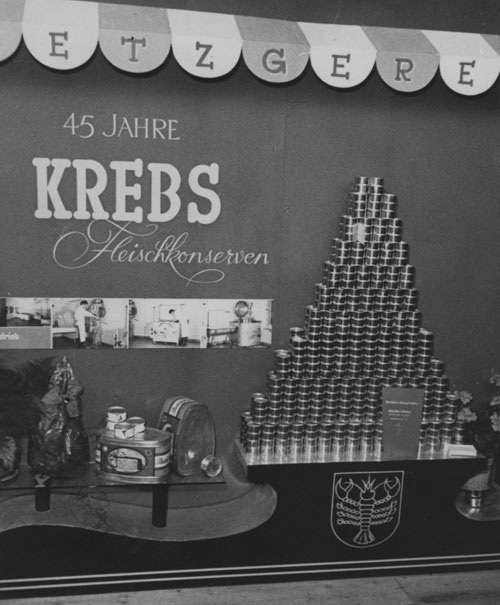
Part of a window display showing some of the thousands of cans Katharina had to stick labels around!
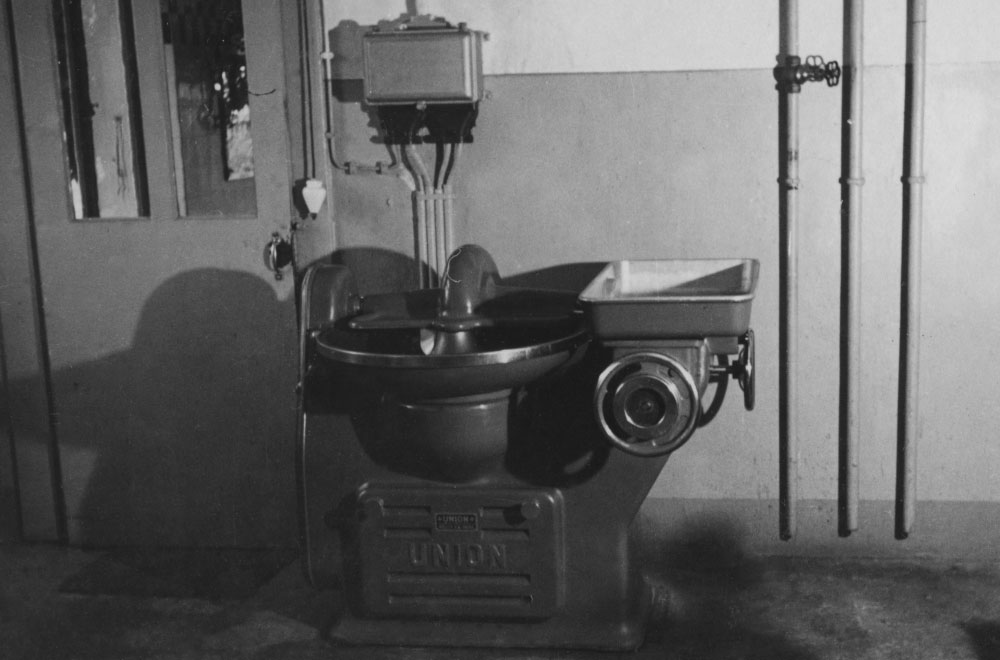
The machine above was used for making the meat “dough” that went into various products such as Landjaeger (Swiss salami sticks), Cervelat (considered the Swiss national sausage) and Bratwurst. The meat was put into the tray on the right hand side. It was minced, the minced meat exiting the machine at the front. It was then manually transferred into the large mixing bowl on the left. This machine also had blades that Katharina had to take out, wash, and put back in.
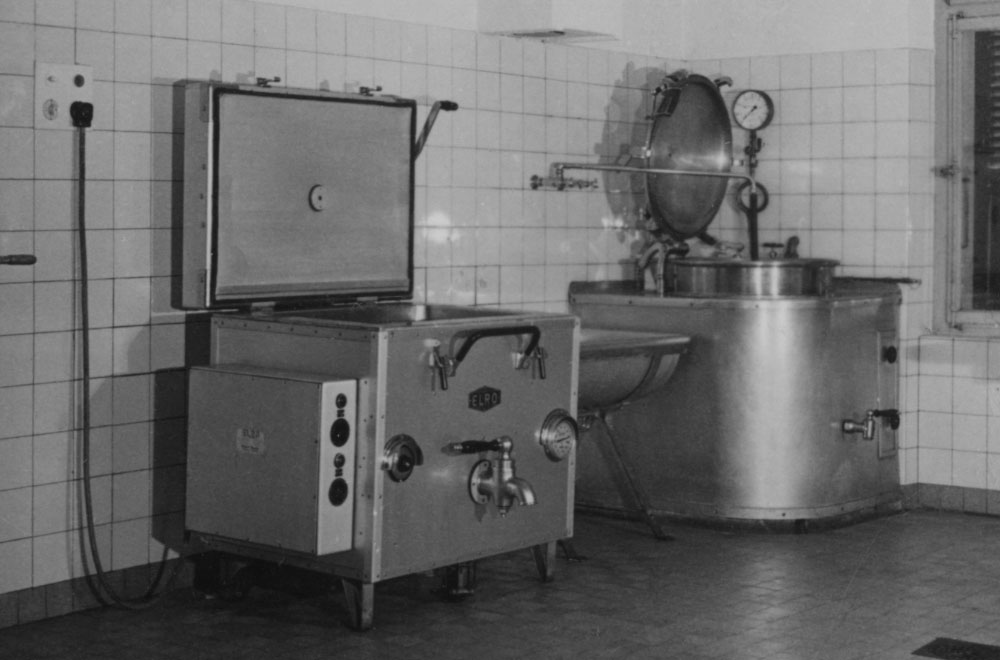
The machines above were used for boiling hams, or anything that needed boiling; the machine on the left was a more modern version of the machine on the right. Workmen would come to the shop at six in the morning for newly boiled pig parts such as trotters, ears and snouts, and would also arrive with containers to be filled with the soup that Katharina’s father made in the boiling machines. Katharina remembers her father making yellow split pea soup and bone broth.
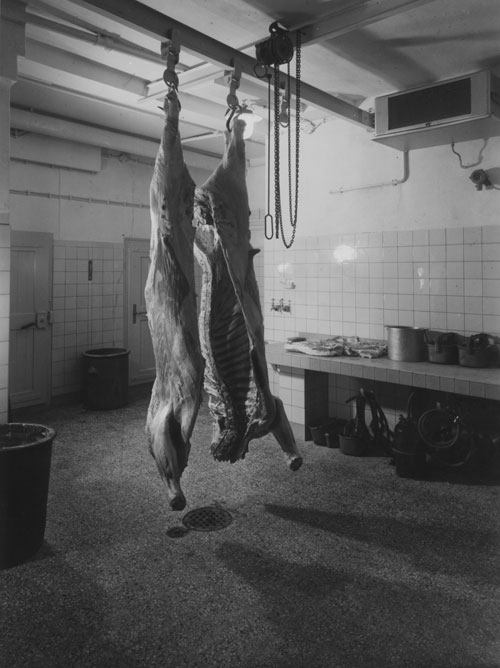
The cold room. The carcasses were temporarily hung here before being cut up on the work surface to the right. Behind the carcasses are two doors: The right hand door led to a “warm” fridge room where items that had to be cold but not frozen were kept. The left hand door led to a freezer room where Katharina nearly lost her life when she was accidentally shut in it. There was also a third door opposite the work surface that led to a room where meat was hung to tenderise.
World War II
During the Second World War, Katharina’s father served as a cook in the Swiss Armed Forces at La Brévine in the Jura Mountains near the French border – the coldest place in Switzerland.
Meat rationing in Switzerland began in 1942 and lasted until 1948. Katharina remembers that it was her job to stick meat coupons from customers onto sheets – a job she loved! Her other memory from wartime is cutting squares out of newspaper and threading them onto a string to hang in all the toilets for use as toilet paper.
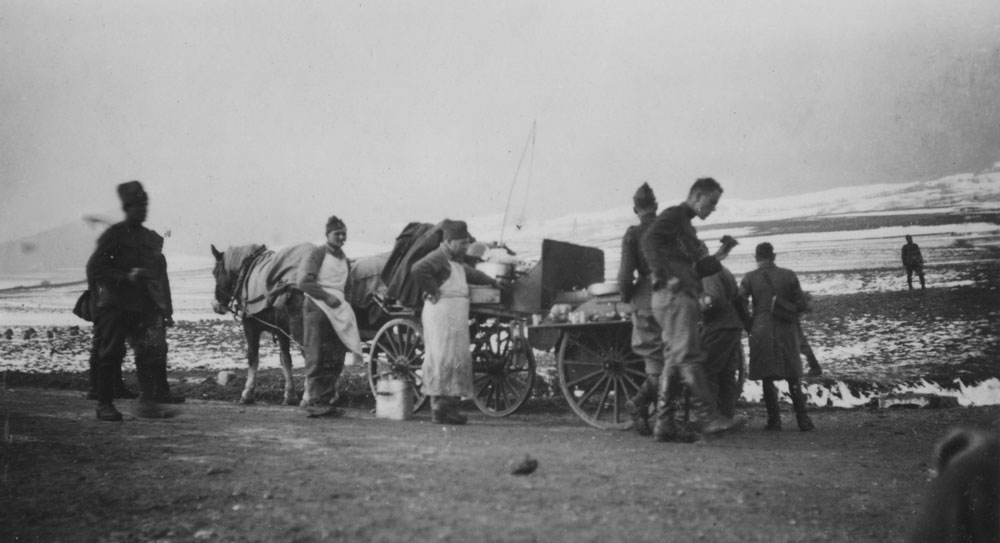
An undated photograph of Swiss Army personnel gathered around a horse-drawn mobile field kitchen / supply wagon in the snow. Katharina’s father Fritz Krebs is the central figure in the long white apron.
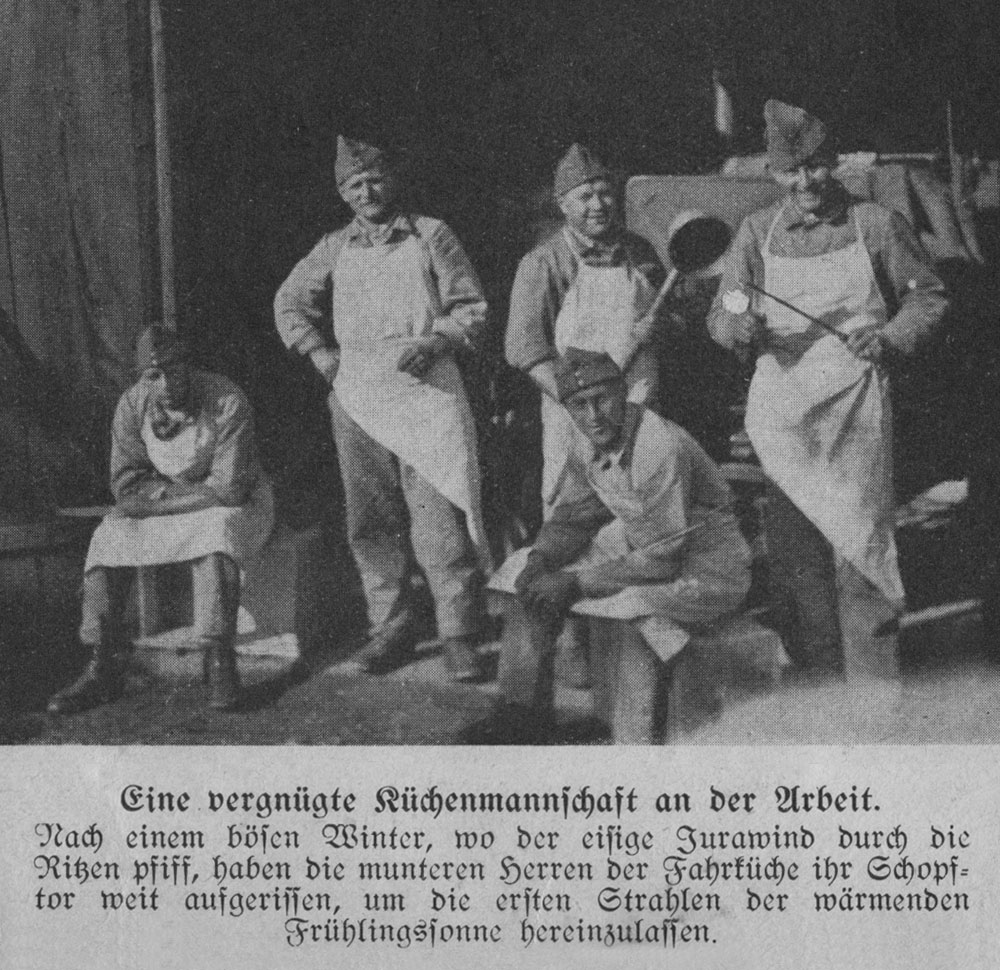
A newspaper cutting captioned “A cheerful kitchen crew at work. After a harsh winter, when the icy Jura wind whistled through the cracks, the lively gentlemen of the field kitchen have flung their shed door wide open to let in the first rays of the warming spring sun”. The cutting is stuck in an album; it is undated and we do not know which newspaper it was cut from. Katharina’s father Fritz Krebs is the central figure holding the ladle.
Delivering Meat
Katharina started delivering meat to customers on her bicycle from the age of four. She received tips from the customers she delivered to, and when she was older she liked to spend the money she had saved on books from the Stauffacher bookshop in Bern.
To this day Katharina always tips people who deliver goods to her house.
Sunday Lunches
Katharina’s father was particularly well known for his hams. These were bought by restaurants in towns as far as 50 miles away from Bern, such as Interlaken, Thun, Spiez, Neuchâtel and Murten.
Often on a Sunday, the family would dine in one of their customers’ restaurants.
Ham Sandwiches at Circuit Bremgarten
Circuit Bremgarten was a motor racing circuit located on the outskirts of Bern. With no real straights, it was fast and dangerous. It hosted the Swiss Grand Prix between 1934 and 1954 (excluding the war years), the Swiss Grand Prix being part of the Formula One World Championship from 1950 to 1954. Bremgarten was closed in 1955 when the Swiss authorities banned circuit racing due to safety concerns.
Katharina remembers walking among the crowds at Circuit Bremgarten selling ham sandwiches from trays. The sandwiches were made in the butcher’s shop from bread delivered by at least three different bakeries. The sandwiches were sold in translucent paper bags bearing the shop’s name.
Katharina’s Grandmother
Because her parents were always busy with the shop, Katharina spent a lot of time with her paternal grandmother who lived on the second floor of the house. Katharina remembers doing her homework on the round table in her grandmother’s room, and that her grandmother would feed the birds outside her window.
“On Saturday afternoons my grandmother would make battered apple for my brother Peter, but she knew I hated cooked apples so she would make me battered Cervelat (Swiss sausage) instead”.
Eventually Katharina’s grandmother was unable to walk down the stairs from her room and Katharina’s father constructed a special chair so that she could be carried.
Katharina was with her grandmother when she died aged 84, when Katharina was twelve. “I had an urge to draw my grandmother – I especially went downstairs to fetch my coloured pencils and card to draw on. When I’d finished my drawing, my grandmother, who was asleep, suddenly slumped forward in her chair. I pushed her back so she was sitting upright. My parents were elsewhere, so I telephoned my uncle. After my uncle had arrived I cycled three miles or so to fetch my parents. My grandmother had had a stroke and she remained unconscious. Some three days later as I entered my grandmother’s room, she was looking up, not at me, but beyond me, and she looked absolutely radient, seeing something that made her very happy. Then she died. Her coffin was made by the carpenter who lived over the road from us and as was the custom then she lay in it for three days in her room while friends and family came to say goodbye. She died on the 29th of February as had always been her wish, so the family would not need to mourn her every year – but of course, I always thought of her anyway and still do today”.
Holidays
Also because her parents were always busy with the shop, Katharina and her older brother Peter spent two holidays at a childrens’ holiday home in Saanen. Katharina remembers that two girls were wiping bogeys onto her brother, so she climbed over the railings of the cot she was sleeping in and beat them up, for which she was punished. Katharina also remembers staying there over Peter’s birthday. Katharina’s maternal grandfather, a baker, sent Peter a glorious birthday cake in the shape of an alarm clock. Katharina, who had to help in the home’s kitchen, saw it, but Peter never did. It was cut up and distributed among the staff and children of the holiday home without being shown to him.
Another holiday, Peter was to stay with an uncle who was a vet. Peter cried and in the end Katharina had to stay with him. Katharina remembers how kind the vet and his family were, and says it was the best holiday ever. She particularly remembers bathing in the horse trough where she was stung by a hornet, and playing hide and seek among the hay racks.