
At the Tea Research Institute in 1948
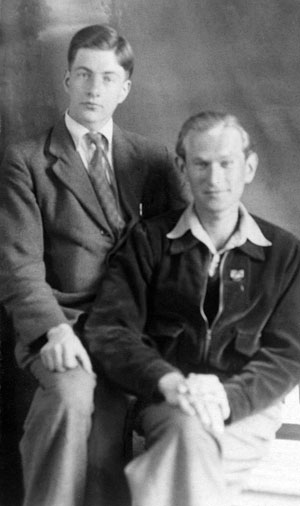
This is a page of extracts from letters that Henry received from his friend Derek Kemp, who had been a fellow Botany student at Chelsea Polytechnic. Derek had gone to work at the Tea Research Institute at the St. Coombs Estate, Talawakelle, Ceylon, and his letters paint a portrait of living in Ceylon as a British scientist at the Tea Research Institute in 1948/1949.
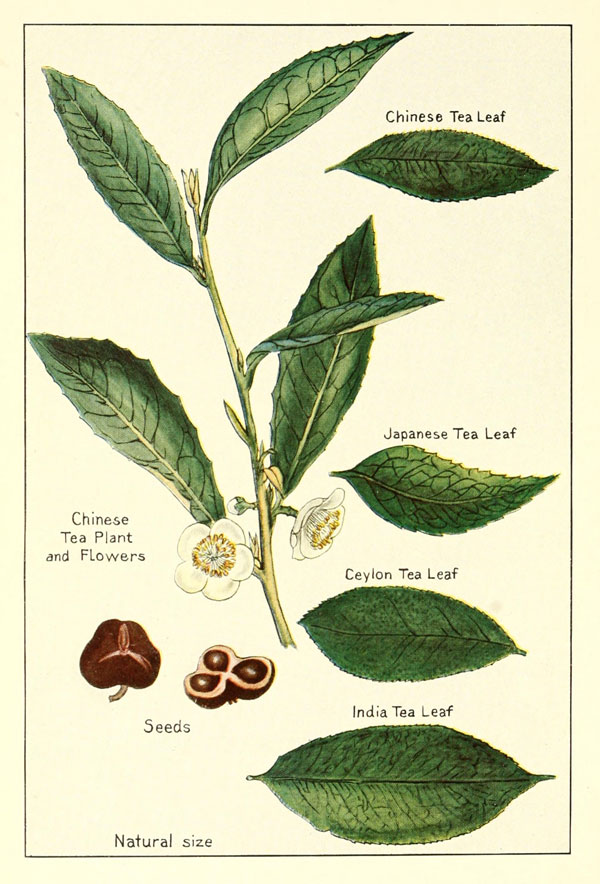
The Tea Research Institute was set up in 1925 for “generating and disseminating new technologies related to tea cultivation and processing”. Derek worked under Dr C H Gadd, who had been employed as the Institute’s mycologist in 1926. Gadd remained a key scientific figure at the Institute until his retirement in 1949, making significant contributions to knowledge of tea diseases including Blister Blight, a serious fungal disease that can greatly reduce crop yields and that Derek was tasked with working on.

Ceylon Countryside and Botany

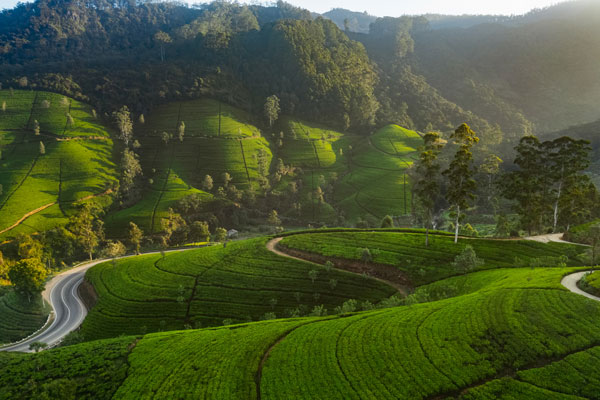
The country here is simply grand, I’m sure you would be most thrilled with it. All around are great mountain peaks, often enveloped in cloud. The roads wind so much round the mountains that you never know which way you are facing, and often you have to stop to let an oncoming car pass you. The tea is planted everywhere, even on the steepest slopes, and among the bushes are shade trees, Grevillea, Acacia, Albizia etc., which are also used as sources of green manure by loppings and leaf fall. One of the commonest ferns here is the maidenhair, also Davallia and many others whose sori I recognise but whose names I have forgotten! I haven’t had time to make a proper study of them yet.
I’m now the proud owner of a bug Fiat car, 6 H.P. Believe me, learning to drive on these twisty roads was no joke, but I’ve managed it and still have my neck.
2,500 ft doesn’t sound very high considering I am living at 4,500 all the time. They say that people out here become quite crazy due to the altitude. It’s a bad look out for me as I was crazy to start with!
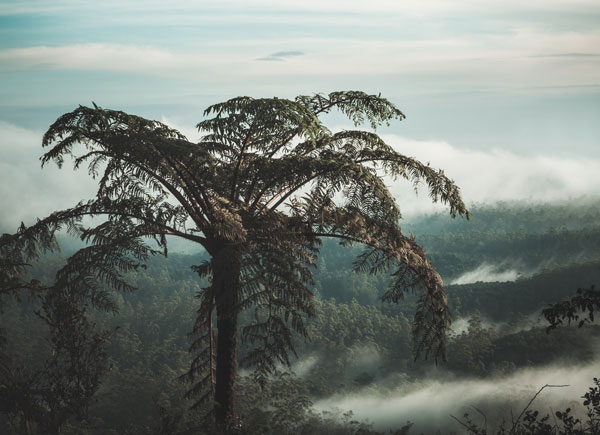
I haven’t done much natural history as there are so many social distractions, but there are a multitude of ferns out here to study. The Tree Ferns, which grow mainly round Nuwara Eliya are most majestic plants, far better in life than any picture or pickle bottle. But here I go again, raving of the beauty of plants, and not caring very much whether they have a reniform indusium or not, or whether it is lacking like my memory!
I wanted to describe in detail my trip to Gampola (near Kandy) where I had to judge a competition of small holdings in tea, but now I’ve written so much, feel too tired. The small holdings are all native owned, mostly Sinhalese (not Tamil as up country) and are very quaint as they grow all kinds of palms and other things, including pepper, in with the tea. Have you ever drunk the clear juice from a young coconut? I had so much its a wonder I didn’t turn into a coconut. I also saw the palm which produces one enormous inflorescence in its life, on its 50th birthday, and then dies. It had been in bloom, and the ground beneath it was peppered with the fruits, most uneconomic, I can’t imagine how it holds ground against other plants, I shouldn’t think many of its offspring get established as the seeds are so crowded.
Home and Garden
Life here is really very pleasant, plenty of food, servants to wait on you, ideal climate etc., but the cost of living is very high, and many things such as clothes, household goods, etc. are much dearer than in England. I have this problem still to face when I start living in my own bungalow. At the moment I am staying with Dr. Norris, the Director, and don’t have the worry about fending for myself. You must tell Riley that I have thrown my ideals to the wind and now take a bath every morning before breakfast. It is so easy when you just have to press a button and the boy fills it for you!
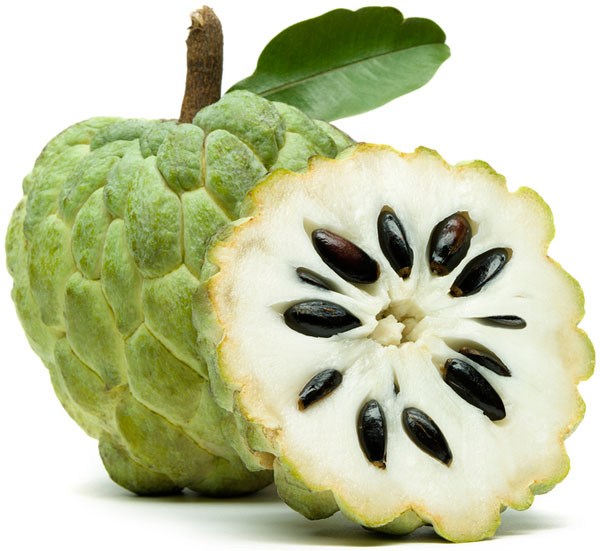
I have been in my own bungalow for about 1 1/2 months now, and am gradually getting used to the responsibilities of a house holder. It is fairly easy really, as the Appu (cook) does everything, and I only have to order things from the shop. I have a kitchen coolie and garden coolie too, and on the whole lead a very lazy, comfortable life. But I don’t very much like living alone, as I have always been used to a lot of people round me at home. In the garden there are two lovely cycads, and also a Kauri pine. I have several grapefruit and tangerine trees too, and have been having their produce with breakfast most mornings. I also have a papaya tree and a custard apple tree. The fruit of the latter is rather sickly and sweet, white and fleshy with numerous large seeds inside. Have you ever had mangoes? they taste a bit like parsnips! There is passion fruit in the garden too, a climbing plant. I also have a small pond and am going to plant some exotic waterlily, pink & blue ones I think. I might even try Victoria regia – the one with huge leaves.
I have been very negligent with my garden lately, but as it’s the dry season and as everyone tells me it’s useless putting anything in now, I have a good excuse. The lawn is turning very brown, and altogether everything looks very dried up. I have a good show of Phlox drummondii which I grew from seed, they are one of the few things I sowed which have done well. Gardening out here seems so different and the sun, even for a short time, seems to scorch anything up so.
Learning about Tea
Now about my work – if it deserves that term! It has been emphasized by Dr. Norris that I should get a good general knowledge of tea production, as this is essential before I can apply my particular side, i.e. mycology, therefore quite a bit of my time I have been going out with the superintendent and looking round the estate or talking with members of the staff about their special aspects. I have been several times to the tea factory which was most interesting. This morning I was practising pruning, what a job – I’m glad I’m not a coolie!
Diagnosing Dead Tea Bushes
We get specimens of tea plants in most days, people asking for the disease from which they died to be diagnosed. Poria, Rosellinia and Ustulina are the commonest fungi on tea, but there are also a lot of animal pests (Ugh – zoology!).
The rest of my work comprises diagnosing dead tea bushes which are sent in from the Planters. I’m even beginning to be able to recognise some of them now. the other day two dead bushes arrived which both Dr. Gadd and myself looked at, and yet could find no fungus or any other apparent causes of death. There was much discussion about them, which was even joined in by the Director and many astounding theories were put forward, e.g. the result of heavy Blister Blight attack, drought, old age !!? and of course I was convinced it was due to a bacterium (why not C. fascians !!?), while Gadd preferred a virus. But was our face red when the Peon (messenger – a very junior lab assistant) had discovered that the roots of the bushes were covered with parasitic eel worms! They live just beneath the bark, and can be seen under the low power after cutting a piece off as tiny somewhat opalescent threads.
Studying Blister Blight
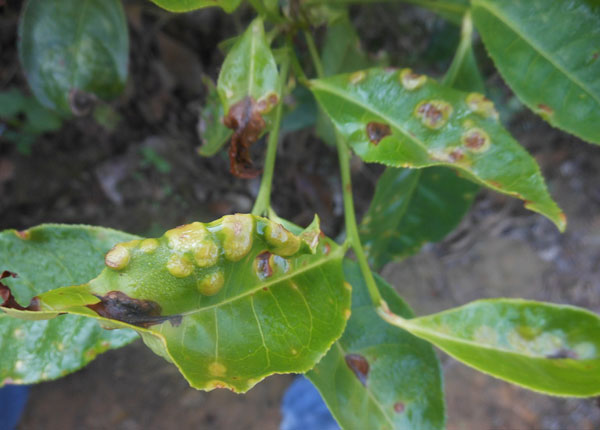
I have been doing a large number of germination tests on Blister Blight spores. The great difficulty is to get constant results as they seem to be very easily affected by the slightest change in conditions.
I think the main trouble is that the thickness of the water film changes during the germination period, and it is very hard to keep it constant. You see you collect the spores on a glass slide direct from a blistered leaf, and spray the slide with water, or put drops on, and put the slide in a moist chamber. But if the water film is too thick, apparently, the spores don’t germinate. Have you any ideas of how to maintain a known water film constant? Actually I am in the process of trying a new method with collodion membranes. I collect the spores on these membranes, and then place them on a porous plate over water. This I hope will give a constant supply of water to the spores. If I can standardise the germination technique there is quite a lot I could do on the varying conditions under which they germinate, which is of quite practical importance since the spores spread the trouble. But until then I’m stuck.
Lately I have been spending most of my time using an apparatus which shall henceforth be known as Kemp’s aeroscope. It is used for collecting spores of the atmosphere, and in particular Blister Blight spores. I will draw a diagram:
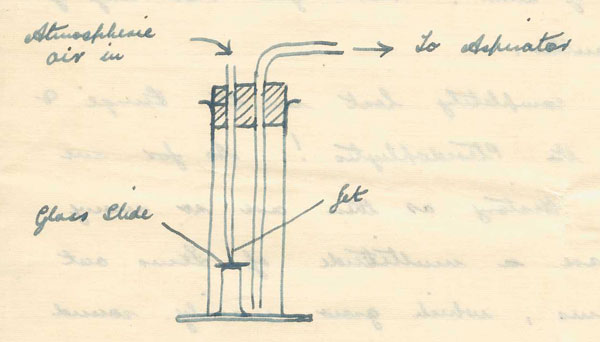
The air of the atmosphere is drawn through the gas jar by means of an aspirator (placed high up to gain extra H2O pressure), and can only enter the jar by the jet (about 2 mm. in diameter), where it impinges on a glass slide with which the jet is in contact. Here the spores, dirt etc. collect, and can easily be examined under the microscope. Knowing the volume of the aspirator one can directly get the density of spores in the air. The only snag is that so far I seem to get rather a wide range of variation on subsequent collections, which surely cannot be real, and one wonders whether some spores are not sticking to the glass of the jet, though from one experimant this doesn’t seem to be the case. For a volume of nearly 20 litres I sometimes catch as many as 40 and 50 spores of Bliser Blight. The idea is to try and correlate spore number with severity of infection in the field and weather conditions.
I am also catching the spores on horizontal slides and counting under the microscope directly, usually leaving them out for 24 hours. Using Stokes Law for falling spherical bodies, one can get the number of spores / volume from these slides, and get results by a different method from the aeroscope to compare. But since B.B. spores are not spherical, & are assumed to have an S.G. of 1 and to fall vertically onto the slide, the calculations using Stokes Law are to say the least of it somewhat theoretical, though they do give some idea.
You asked whether glycerine was necessary in the aeroscope, – the answer is no, Blister Blight spores are so sticky themselves that an adhesive is superfluous, in fact the whole trouble with some of the method was that the spores stuck to the jet before they ever reached the slide. This caused me to get very odd results, as if I used a tube which had been used for collections on the previous day, the first collection would be high, followed by a low one. Apparently spores which were caught on the jet the day before would come off the next day with the current of air. I tried using clean jets, and then trying to remove the spores the next day by a current of air, but it didn’t always seem to work. Finally I abandoned the aeroscope for this reason. Really I think the 24 hour exposure of slides is best, although much simpler.
The other work I have been doing is on secondary invasion by other fungi of tissues infected with Blister Blight. This is a fairly new phase of things, and once it got round, of course all the planting community thought that the T.R.I. had discovered some miraculous fungus which would “kill” all blisters and eliminate Blister Blight. In actual fact the secondary fungi can stop the blister maturing, if they get in early enough, and so prevent spores being formed, but since that doesn’t happen to all blisters it doesn’t seem very likely that it will much affect the spore population of the air which is so enormous. Actually Dr. Gadd discovered this secondary attack which is mainly due to Colletotrichum camelliae, the fungus which causes the Brown Blight leaf disease of tea. But various other fungi do the same thing, and I have isolated a species of Phyllosticta from decaying blisters, which also proved to be a secondary parasite.
I expect by now you are quite convinced that I am dead, probably as the result of a new biotic strain of Exobasidium vexans [cause of Blister Blight] pathogenic to man, but in actual fact I’m still in the land of the living.
Believe it or not, after months of doing other problems, I’ve come back to the germination of Blister Blight spores again. Dr. Gadd said formally they got the best results during the dry weather (at last there is no monsoon, neither N.E., or S.W. or little monsoons or intermonsoons that people talk of out here) so I’m trying a new approach to the matter. You remember I told you the trouble is that Blister Blight spores ain’t like those of any well disciplined self respecting fungus (such as Botrytis cinerea!) and just seem to germinate when they feel like it, though bad B. is invariably obtained when the spore deposit is heavily wetted with water. This made me think that oxygen supply has something to do with it, so I’ve been trying germinations in aerated and oxygenated water. These seemed to give little better results than ordinary water, so now I’m germinating spores in air and various concentrations of oxygen, working (or should I say “wer-r-king”) on the lines of Prof. Browns experiments on the conditions of fruit storage as per Annals of Botany (1922 I think). So far the results are disappointing, but my hopes are high. Anyway I’ve had quite a bit of fun playing at chemistry making oxygen.
An Incident with Nuns
One day I was just about to heat my mixture of Mn O2 & K Cl O3 when in pranced (actually sedately moved) two nuns who were collecting for something or other. Wishing to impress them how scientific I was I decided I would demonstrate the wondrous and mystical evolution of oxygen to them. Gayly brandishing the burner (not a Bunsen, ours work on petrol vapour) beneath the reaction tube, and describing what was to – or what should, happen, I was a trifle disconcerted when the reaction went with a rush, the pressure of gas blew off the cork of the reaction tube, my water displacement collection apparatus sucked back into the wash bottle of concentrated NaOH, which was shot all over the terrified nuns!
The one had a burn on her forehead and spots on her clothes, though the other escaped more or less unharmed. We did our best to wash their clothes and treat the burn, but I’m sure I’ll never try any more demonstrations in chemistry, though I doubt that we’ll see those nuns for a long time. Now, thank goodness, we have an oxygen cylinder, and provided the tap doesn’t shoot out with 200 lbs pressure behind it, things are a little safer
Socialising
Sometimes I feel rather cut off out here, as we are seven miles from Talawakelle , and that is only a tiny place. Of course there are no buses, and one really needs a car. I get to the local club most Saturdays, but that is about five miles away. There is nothing but tea at St. Coombs.
I do miss the social attributes of London, and get rather tired of the clubs. One meets the same people all the time and ends up by drinking too much. I even play Rugger as a means to gain social success. A good sportsman is always popular out here, as sport is the main preoccupation (other than drinking!). But I much prefer tennis and badminton.
Perahera
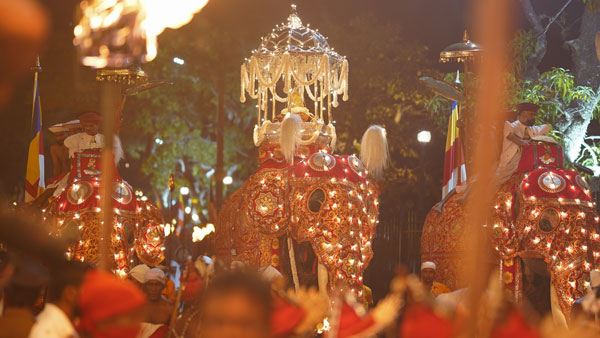
Last week I had 4 days leave which I spent in Kandy. I went down for the big annual Buddhist Festival, called the Perahera. It lasts several weeks, but gets more and more spectacular as time goes on, and I went for the last few days. They have a wonderful procession of elephants, all dressed up in various coloured trappings. This took place each night, there were only about 50 elephants on the first night I was there, but at least 100 the last night. The whole thing is lit by flaming torches, and the procession preceded by men cracking whips. First comes an old man with a long beard carrying the proclamation saying that the Perahera can be held (he is on an elephant of course), then the keeper of the Temple of the Tooth walking on foot (he wears a loin cloth of 40 yards of material which it takes him three hours to get into!) followed by the sacred tooth itself concealed in a casket carried on an elephant’s back, and protected by a kind of roof like a shrine. This is said to be the tooth of Buddha, and is 2000 years old! (supposedly). It is only exposed on very rare occasions. There were numerous dancers in the procession, notably the Devil Dancers who wear a fascinating dress largely made of beads & little circular pieces of metal which jingle as they dance. Their hats were broad brimmed like Mexicans! Lotus blooms were thrown over the tooth as it went along. There were numerous other elephants bearing caskets containing Buddhist relics, and a man blowing flame from his mouth (he was drinking from a bottle of kerosene oil and lighting his breath!). It was all most interesting and well worth seeing.